The Research Council of Norway (NFR) has launched a National Roadmap for Research Infrastructure in Norway. The roadmap is based on advice given by NFR to the authorities for an internationally competitive strategic plan for national infrastructure building based on official research policies and priorities. The roadmap is followed by long term planning and investments in large scale research infrastructures. 17 out of 260 projects were included in the roadmap, rated by the three criterias; 1)Infrastructure of national character, 2)Large scale research infrastructure and 3)Excellent rating of professionalism and strategy. Among the exclusive projects included in the category Large Scale Equipment Facilities are Norwegian Centre for Minimally Invasive Guided Therapy and Medical Technologies (NorMIT). NorMIT is a collaboration between St. Olavs Hospital, NTNU, SINTEF, University of Oslo, Oslo University Hospital and the Interventional Centre. The Operating Rooms involved are modern research laboratories where new technologies, treatments and medications are implemented. Collaboration and work assignement within image guided therapy and medical tecnology will take place in NorMIT. The over all objectives are better and safer patient treatment outcome, reduction of complications and length of stay, and to produce cost-effective solutions for healthcare and the society.
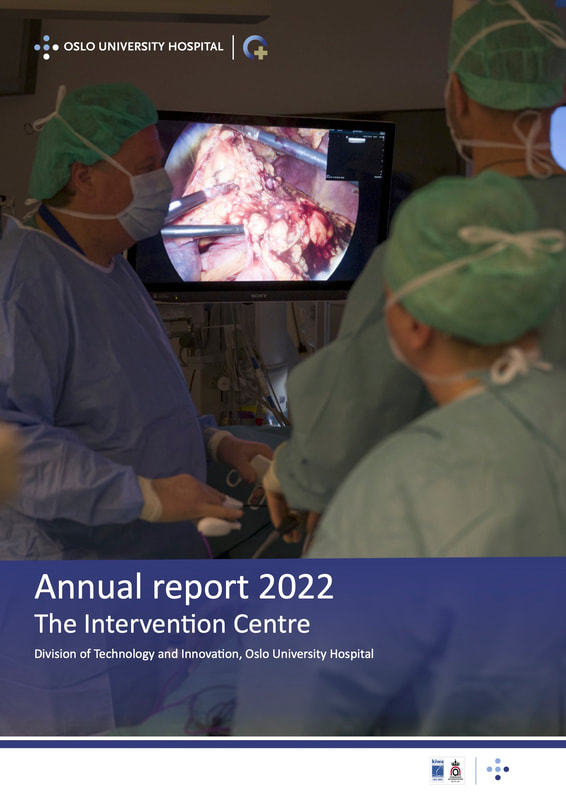
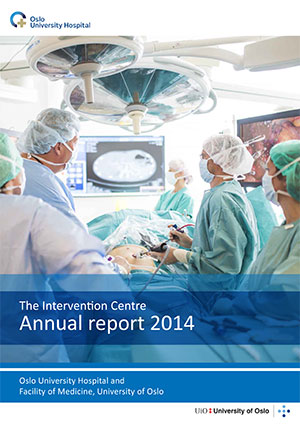
A team of abdominal surgeons at The Interventional Centre, led by Bjørn Edwin MD,PhD, has performed a laparoscopic distal pancreatic tumor removal and splenectomy using only one single incision. The team was the first in the world to report on use of this particular minimally invasive surgical access for this type of complex laparoscopy. The new, specially designed quad-port trocar device used for surgical intruments access was placed in the patients umbilicus. Customized, curved laparoscopic instruments were used to perform the surgery in a surgical procedure normally requiring at least 4 to 5 separate instrument trocars. By this technique the patient is left with less surgical scars, and the postoperative pain will be reduced due to less surgical trauma caused by the procedure. On the image the single trocar and the curved instruments (on the video screen) can be seen. An image of the post-operative surgical scar and the quad-port trocar can be seen in the Read More>> section.
Physiological Measurements has made a special collection of top rated papers that represents the excellence of the work published in 2009. Among the 13 papers selected for the presentation of outstanding new research was the article Validation of cardiac accelerometer sensor measurements written by Espen W Remme1, Lars Hoff2, Per Steinar Halvorsen1, Edvard Nærum1, Helge Skulstad3, Lars A Fleischer2, Ole Jakob Elle1 and Erik Fosse1. Author affiliations 1: The Interventional Centre, Oslo University Hospital, Oslo, Norway. 2:Vestfold University College, Tønserg, Norway. 3: Department of Cardiology, Oslo University Hospital, Oslo, Norway. The full text paper may be freely downloaded. The article describes a study where the group of researchers has investigated the accuracy of an accelerometer sensor designed for the measurement of cardiac motion and automatic detection of motion abnormalities caused by myocardial ischaemia. The video shows a robot arm attached next to the sensor. In this setup, both the robot and the sensor recorded the motion of the heart, which facilitated comparison of the sensor measurements with the robot.
This is a video from the final demo of the BWSN2 (Biomedical Wireless Sensor Network) Project. The project objective was to implement wireless sensors from multiple vendors on a commercial software platform. The 802.15.4 Wireless Personal Area Network radio frequency standard operating in the 2.4 GHz ISM band was used in the project. The Scandinavian BWSN2 Consortium consisted of sensor developers, research institutes and the clinical test facilities at The Interventional Centre. MemsCap as, SINTEF IKT and Novelda as came from Norway. From Finland VTT participated. From Sweden Novosense AB, Imego and Millicore AB participated, and from Denmark Delta. The sensor portfolio was implemented on software from the Norwegian company Imatis as. The project was funded by SNN and NICe
ESMRMB - European Society for Magnetic
Resonance in Medicine and Biology has placed its School-of-MRI in Oslo from June 3-5th 2010. More information and online registration is available from the course website. The cource topics are Advanced Neuro Imaging - Diffusion, Perfusion, Spectroscopy. Local Organiser is professor Atle Bjørnerud from the Interventional Centre, and the course venue is Oslo Univerity Hospital. The aim of this course is to convey in-depth knowledge about advanced
functional MR techniques for imaging of the central nervous system. The
combination of MR physics (at a level for radiologists) and clinical
applications in this course provides an excellent opportunity to improve
the understanding as well as the clinical interpretation of
diffusion-and perfusion-MRI and MR spectroscopy.
On January 20th 2010 Lars Mathisen defended his thesis from the Interventional Centre and Dept. of Thorasic and Cardiovascular Surgery, Oslo University Hospital, Rikshospitalet and Faculty of Medicine, University of Oslo. The evaluation committee consisted of 1.opponent professor, Emerita Judy Watt-Watson, Centre for Advanced Studies in Professional Practice, University of Torointo, Canada, 2. opponent professor Rune Haaverstad, Dept. of Thorasic Surgery, Haukeland University Hospital and committee leader profesor Theis Tønnessen, Dept. of Thorasic Surgery, Institute for Hospital Medicine, University of Oslo. The dissertation was lead by the University representative professor Lars Gullestad from Department of Cardiology, Institute for Hospital Medicine, University of Oslo. The quality of life studies performed by Lars Mathisen was based on follow-up studies of patients enrolled in the Off-pump project, a randomized clinical trial comparing off-pump and on-pump coronary artery bypass surgery. So far 5 PhD's has been produced by this project material. Abstact; ”Patient-reported outcomes after on-pump and off-pump coronary artery
bypass surgery” Patients’ self-report of symptoms, health status and overall quality of life reflects the experience of ischemic heart disease, as well as the impact of coronary artery bypass surgery (CABG).
Xuedong Liang defended his thesis in a dissertation originating from the Interventional Centre, Oslo Univerity Hospital Rikshospitalet and the Precice Modeling Group, Department of Informatics at University of Oslo on December 21st 2009. The first opponent was Professor Xiaoming Fu, Institute of Computer Science, Georg-August-University of Goettingen, the second opponent was Research Scientist Yan Zhang, Simula Research Laboratory and the commision leader was Associate Professor Martin Steffen, Department of Informatics, University of Oslo. The main superviser was Ilangko Balasingham, and co-advisers were Olaf Owe og Einar Broch Johnsen. The university representative at the dissertation was Dag Langmyhr. Xuedong Liang's work included 10 scientific papers (authored and/or co-authored) rated as not trivial by one of the opponents, but rather as improtant contributions on the QoS field. The topic of the trial lecture was Localization in Wireless Networks.
Tora Aasland, Minister of Reserach and Higher Education from Ministry of Education and Higher Research visited the Interventional Centre after a 3 hour meeting at Rikshospitalet Oslo University Hospital (OUS). The Minister met with leaders from Pharmaceutical industry including Karita Bekkemellem (The Association of the Norwegian Pharmaceuitical Industry-LMI), Gunnar Sæther (MSD), Erlend B. Smeland, leader of Research and Innnovation at OUS, Steinar Aamdal, MD, leader of the Clinical Research and Test Unit at Radiumhospitalet OUS and professor Erik Fosse from the Interventional Centre. Among topics discussed were how to improve collaboration between pharmaceutical industy and Norwegian hospitals and what role the government could play. One of the objectives of LMI is to increase the pharmaceutical research in Norway. After the meeting the Minister visited the clinical facilities at the Interventional Centre and was guided through the specialized operating rooms by research nurse Karl Øyri. See the LMI website for more information (in Norwegian) >>>. Photo: Marianne H Aandahl, Federation of Norwegian Industries.
Anesthesiologist and PhD student Søren Pischke was awarded an Abstract Price at the 2009 Autumn Meeting of the Norwegian Anesthesiology Society. The abstract describes researh work performed at the Interventional Centre and is presented here: Hepatic and intestinal PCO2 measurement for real-time detection of hepatic artery and/or portal vein occlusion.
Liver ischemia is a potentially life-threatening condition occurring in the course of liver transplantation, liver surgery and circulatory shock. Following liver transplantation hepatic artery (HA) stenosis and portal vein (PV) obstruction occur in 3 – 12 % of the patients, and more frequently in children than adults. Today, standard of care is Doppler ultrasound and liver enzyme assessment daily. Accordingly, detection of severe hypoperfusion may be delayed. Continuous monitoring of intrahepatic and intestinal PCO2 may be an opportunity for early detection of ischemia as tissue CO2 increases during ischemia by HCO3 buffering anaerobically produced lactic acid.
Blood flow reduction in either HA, PV or both leads to alterations in intermediary metabolism in the liver. Intrahepatic and intestinal CO2 measurement as a marker for anaerobic metabolism detects these changes and enables correct diagnosis of the affected vessel.
Bjørn Erik Mørk defended his thesis Changing practices- A practice based study of cross-diciplinary technology development in hospitals from the Interventional Centre, Oslo University Hospital, Rikshospitalet, Faculty of Medicine at University of Oslo, Department of Leadership and Organizational Management, BI Norwegian School of Management, Oslo and Institute of Health Management and Health Economics at University of Oslo. This study examined why breakthroughs in knowledge may fail to be translated into medical practice. These novel practices often lack alignment with existing practices, or they cut across established professional boundaries and power structures. Despite this, we know that establishing practices across heterogeneous groups of actors, i.e. science, politics and industry, can facilitate interactive innovations. This project investigated how this was accomplished in practice in the context of cross-disciplinary technology development in hospitals. The dissertation is based on a longitudinal study of the Interventional Centre, Oslo University Hospital, Rikshospitalet, Norway.
Magnetic Resonance guided High Intensity Focused Ultrasounds (MRgHIFU) has recently been installed at the Interventional Centre – Rikshospitalet by Philips Healthcare [1]. This is one of the few systems available in the world for completely non-invasive (without any inonizing radiation involved) treatment of Uterine Fibroids [Figure 1]. Patients treatment is about to be started in a few weeks.
MRgHIFU [2,3] may be a disruptive technology in the future by its total non-invasiveness compared to surgery or even radiation therapy where unwanted ionising radiation dose deposits always is an issue. Thus, target tissues (fibroids and tumours) can be destroyed without any device insertion in the body. Figure 1: Shematic view of MR guided HIFU treatment of Uterine Fibroid (Courtesy: Philips Healthcare, The Netherlands). Klick image for larger view.
The Initial Training Networks project IIIOS is initiated by Andreas Melzer at University of Dundee. Reserarchers from the Interventional Centre have formerly collaborated with Dr Melzer through the Society for
Medical Innovation and Technology (SMIT). The Interventional
Centre will be responsible for research and training in MR image guided cardiovascular procedures. The Interventional Centre will participate both as a clinical and technological partner in this field. Research will include new concepts to improve the intraoperative MR suit and the hybrid angiographic room through the development of new intraoperative image navigation tools. Ole Jakob Elle and Per Kristian Hol will coordinate the
participation from IVC at a technological and clinical level respectively, and Frederic Courivaud will be responsible for the MR-related technology development.
IVS will be funded by 74 person months and given a total budget of approximately 4 mill NOK over four years by the project. The funding might be subject to changes through negotiations with the European Commision.
English is the main language in this web portal. Some information is also available in Norwegian 
The Interventional Centre receives donations to medical research. Questions related to donations can be sent to head of department professor Erik Fosse.
This site complies with the HONcode standard for trustworthy health information:
verify here.

Author: Erik Fosse
Publisher: Det Medisinske Selskap 2007
Price: 180 kr
Online order
Also sold in Bookstores